
Carbon dioxide removal (CDR) needs to grow from kiloton to gigaton scale in just a few decades, so naturally we tend to think that big scale will require big direct air capture (DAC) plants, big biomass systems, big mineralization hubs, big everything.
But in thinking big, we may be overlooking the power of small—as in small CO2-collecting garbage cans, rooftop units, utility-pole attachments, freeway sound barriers, tunnel vents, and other city-size installations whose power isn’t their sheer size, but their numbers.
Before we explore this idea, let’s list a few important caveats. This isn’t a research paper. The assumptions made here—about future sorbent performance, airflow dynamics, maintenance requirements, regeneration energy needs, public participation rates, long-term costs and more—are all back of the envelope calculations, not carefully thought-out recommendations ready to be implemented. So go along for the ride here, imagine a world where your carbon trash gets picked up from the curb every Wednesday, and then judge whether this approach might be worth taking a closer look.
The case for a city-based approach
Why cities? There are many reasons—these might be the top five:
- Location, location, location: First and foremost, cities are ground zero for CO2 pollution—cars, factories, homes, construction. UNEP estimates that fully 70 percent of annual CO2 emissions come from cities. Cities are also full of wind tunnels (think freeways), which means we may not need to rely on electricity-driven fans to move air through our CO2 collection devices. As well, CO2 levels are generally elevated in urban settings—tunnels, large commercial buildings, freeways again—giving our collection devices a richer target environment. And then finally, there’s the supporting infrastructure: everything we need for operating and sustaining this system is close at hand, from maintenance crews to roadways to ratepayers who will ultimately be footing the bill. In real estate, it’s all about location.
- Experience: Carbon dioxide is a waste product, and cities already have centuries of experience managing waste. Household trash, recycling, water systems—plus non-waste infrastructure systems like power and communications—are all services that cities know how to build and operate. They know the model for construction, finance, service, regulation, and maintenance.
- Distributed risk and action: A city-based approach spreads the risk of CDR investment, magnifies the lessons we can learn as hundreds of these projects scale around the world, and increases the chance action will happen. We move from relying on only a handful of governments to take massive action, to incentivizing smaller action across many locations.
- Lower costs: Cities will each be investing billions of dollars in CDR projects, but while this figure is large, it’s also more realistic than the trillions countries will need to invest for a suite of “national-size” CDR projects. Many small bites at the apple might be easier to finance than a few huge bites, with the investment spread across thousands of local bond issues and millions of ratepayers.
- Scalability: Cities provide built-in scaffolding for scaling—built-in customers, familiar processes, publicly owned land—a blueprint for action that can be easily replicated, established political networks for sharing best practices, and established mechanisms for financing infrastructure. There is nothing new with CO2.
What the system might look like
In this model, the backbone of a low-risk, low-energy, low-cost urban CDR system is DAC—more specifically, static sorbent units deployed across multiple city locations. Other add-ons are possible—rooftop gardens (which can also help lower urban temperatures), biochar facilities, smokestack scrubbers and more—but the core CDR systems would be DAC. Static units are preferable to units that require blowing air to operate—the operation and maintenance costs are lower, the energy requirements and costs are lower, and given recent advances in sorbent technology and readily available wind tunnels in big cities, fans wouldn’t be needed anyway.
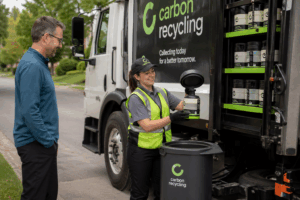
Individual homeowners would manage small garbage can-sized CO2 collection units that get picked up bi-weekly along with their trash, compost and recycling bins. Apartment buildings and commercial buildings would host larger rooftop and HVAC-adjacent systems. Highway noise barriers would be outfitted with carbon-collecting walls, especially where traffic-driven airflow and elevated CO2 concentrations improve uptake (this added insulation would also help reduce traffic noise). Tunnel and transit ventilation systems would use existing forced airflow to increase contact with sorbents. Municipal infrastructure—utility poles, parking garages, bus depots, public buildings, and waste-transfer stations—would all also provide additional low-friction deployment sites. At the periphery of cities and in vacant public spaces (think buffer zones around airports, ports, power stations and rail yards), large passive collection arrays would operate; even larger arrays would be stationed between cities, and also serve the regional CO2 processing needs for multiple cities (existing waste stations might be retrofitted for this purpose).
The first-generation version of distributed CDR collection units would use regenerable sorbent systems. These systems use solid materials—amine-functionalized sorbents, ion-exchange resins, porous polymers, metal-organic frameworks, or related materials—that adsorb CO2 from ambient air over time. Once saturated, the sorbents must be regenerated so the captured CO2 can be released, concentrated, and either stored or reused. This would require a maintenance system where on carbon bin pick-up day, old cartridges are swapped for new ones and the old cartridges are taken to our regional regeneration hubs.
In some environments, these sorbents might use moisture-swing technology instead that requires only water mist to release captured CO2. These collectors would work efficiently and effectively in arid desert cities, for example, while locations like London and Seattle would no doubt deploy sorbent technology that didn’t need to be waterproofed.
Second-generation (2G) collectors fundamentally change the scale and logistics of the urban CO2 trash system. More efficient sorbents will come first, followed eventually by capture methods that can transform CO2 directly into solid form:
- Metal-Organic Frameworks (MOFs):Often described as “molecular houses,” MOFs are highly porous crystalline materials with enormous surface areas—a few grams can equal the area of several football fields.
- Graphene Nanomembranes:These are atom-thick sheets of carbon with precisely etched pores that act as a molecular sieve. By selectively filtering CO2 at the atomic level, these membranes can feed a continuous stream of carbon into a solidifier, potentially removing the need for chemical solvents or thermal regeneration entirely.
- Direct Liquid-Metal Conversion:Using liquid-metal catalysts (like gallium-based alloys), these collectors convert CO2 gas directly into solid carbon flakes at room temperature. The carbon simply flakes off the catalyst and accumulates as a stable, inert dust that can be collected like common dry waste.
- Carbon Nanotubes (CNTs):Instead of just trapping CO2 as a gas, these systems use the captured carbon to grow solid carbon nanotubes. This turns the CO2 into a high-value industrial super-material. Because the final output is a solid, tangles of these tubes can be harvested like wool, eliminating the need for complex gas-regeneration cycles.
This transition to 2G matters enormously for the success of our city-based collection scheme. For one, these new collectors will be much more capable, and will allow CDR to grow from megaton scale to gigaton scale. Also, processing will simplify. Instead of collecting chemically saturated cartridges and transporting them to energy-intensive regeneration hubs, cities might simply empty carbon bins the way trucks empty trash, compost and recycling bins today. Service intervals could also lengthen from weeks to months, further simplifying system maintenance.
How this scales
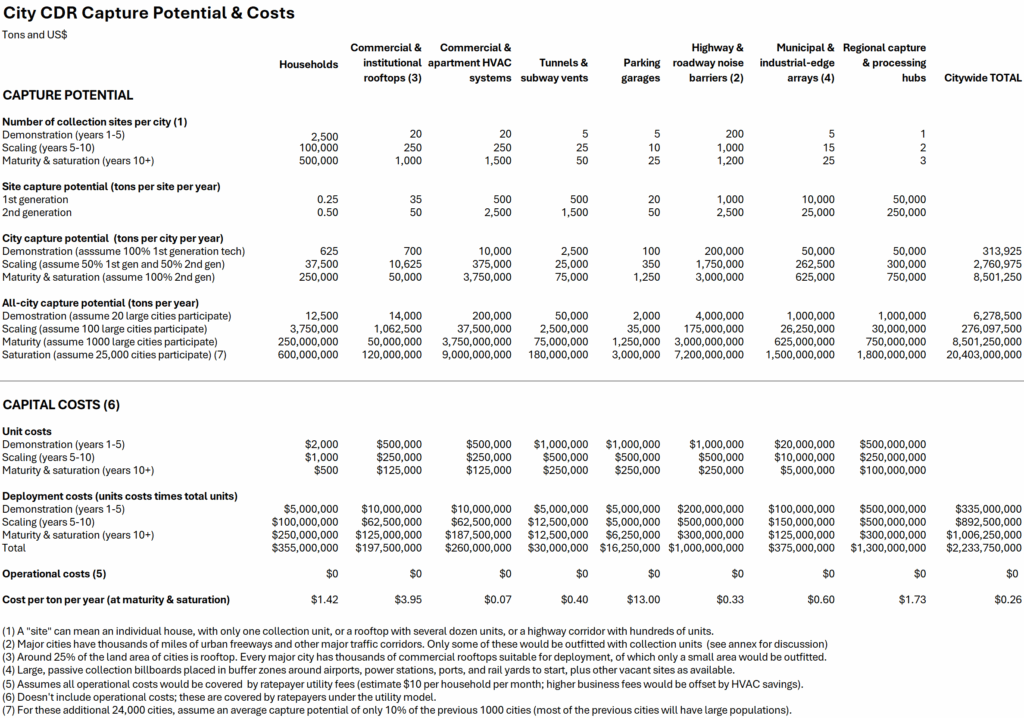
As the table below shows, large cities might eventually deploy thousands of small collection units. The effort would begin with 20 cities conducting a five-year-long demonstration project, expanding to 100 cities in the scaling phase. After ten years of testing and refinement, a thousand cities or more can then start deploying mature CO2 collection systems.
The resulting impact multiplies quickly with participation, especially after the transition to 2G systems. (For our purposes here, we reach “maturity” at 1,000 cities with populations of 500,000 or more, although scaling to tens of thousands of cities might also happen.) Highway-edge collectors deployed at scale, for example (using very conservative estimates—see the Annex section for discussion) might by themselves be able to remove around three gigatons of CO2 annually, and commercial HVAC scrubbers nearly four. If major cities wanted to focus on just one or two types of CDR deployment, these two solutions alone might deliver eye-popping returns on investment.
And how will we pay for all this? The numbers we’re using here are loosely based on ballpark manufacturing, construction and industry costs. Assuming they are somewhat defensible, then demonstration deployment might cost a major city on the order of $350 million, with scaling and maturity costing around $900 million and $1 billion respectively. While this is a lot of money, these costs are not out of the norm for what large cities otherwise budget for road, bridge and sewer repairs. They can also be financed through familiar mechanisms like bonds, with ongoing costs (for collection, maintenance, processing, and capital investment) managed in familiar ways through utility fees. Governments might even offer to cover construction and procurement costs through grants or tax breaks, with ongoing maintenance costs left up to ratepayers (e.g., where customers might pay an additional $10 per month for their carbon-bin pickup).
The payoff? If all these stars align, we could easily reach multi-gigaton scale carbon removal in a reasonably short period of time, and do this in a way that is sustainable, normalized, and avoids the need to worry about how we will finance and build massive CDR facilities. The efficiency verdict is compelling too: Instead of thinking in terms of hundreds of dollars per ton, the cost per ton for a global city-based CO2 collection system might end up being staggeringly low (without factoring in ongoing operational costs, which would be supported by ratepayers through a modest monthly fee). Indeed, cities might even see a strong return on their investments—even full cost recovery—not just through cleaner air, but by selling collected CO2 instead of burying it as technology and carbon markets evolve.
What the critics will say
Cities haven’t always been in the infrastructure business. Most of our modern givens were once fierce battlegrounds of public policy. In the mid-1800s, critics mocked the idea of standardized municipal trash collection, with many viewing organized sanitation as a wasteful endeavor rather than a public necessity. During that same era, calls for integrated municipal sewage systems were often met with intense skepticism regarding the astronomical costs and engineering “impossibilities” of plumbing entire cities. As the century progressed, the expansion of rail and telegraph networks was decried by those who saw public oversight as an overreach that would stifle private trade. Even as recently as the early 1900s, the push for rural electrification was met with claims from private utilities that it was a “financial impossibility” to power the outskirts of the nation.
Yet, each of these systems eventually became the backbone of modern life. The time has come to recognize that cities have a responsibility to clean up the carbon waste they dump into our atmosphere.
There will no doubt be critics—of the need, the cost, the practicality, and the technology—just as there were for every utility that came before. Technology critics, for example, might say that static air DAC units can never compete with forced air units. Without fans, so goes the thinking, sorbents will not be exposed to enough air to capture enough CO2. However, the city-based model only requires that each collection unit capture a small percentage of CO2. Numbers do the rest, not force; capturing a few percent each from thousands of units adds up to more than 90 percent from a few units. Furthermore, the air in question isn’t necessarily static. Natural turbulence in traffic corridors increases the collision frequency between CO2 molecules and sorbents without using fans.
There will also be those who criticize whether we’re ready to start thinking along these lines since 2G technology is still in the lab. We may not be far away, though—a few modular 2G units are already being piloted in high-value urban sites. For example, in Germany, Meloon is testing its graphene-based “Magic Filter” membranes, and Carbon Xtract in Japan is deploying nanomembrane-based decentralized capture units. Market analysts project that this technology will begin scaling significantly in the 2030s.
If these projections are accurate, then why not wait until the 2030s to get started? Why start deploying messy first-generation chemical sorbents now if 2G systems are right around the corner? This isn’t an unreasonable strategy, and we may end up doing this anyway since it will take time for cities to think about their CDR futures and have their voters approve action plans. But starting to think about this model now, and even begin demonstration projects, would mean getting a head start on building the necessary public support, establishing collection and processing systems, and more—not just for home units but for highways, tunnels, and other urban systems—so that as sorbent technology improves, the people, processes, equipment, buildings, and tax systems are already in place to make a seamless transition possible from old technology to new. Think “building the logistics of the 1990s internet today to be ready for the bandwidth of the 2030s.” Once we get everything in place, we can hot-swap the new technology for the old.
Of course, maybe we’ll decide it will be easier to set up these collection systems in remote areas instead, far away from cities, where carbon farming and storage can be vastly simplified. There are pros and cons to both approaches. Carbon farms might be easier to operate but they might also require huge amounts of land and electricity to operate, and they may not operate as efficiently as in carbon-rich urban environments. Huge farms might also create choke points for financing and technical failure, whereas a distributed city-based approach spreads risks and accountability, continues to encourage efficiency and innovation, and also makes financing and sustainability more plausible.
This financing is another major question mark. Will cities be able to find a billion dollars apiece to build these systems? While investments of this size are relatively affordable for major cities, they’re also usually for tangible upgrades like roads and bridges. Why would cities agree to levy a $2 billion tax on citizens for carbon removal? Until there’s a compelling reason to do this—see also the previous discussion about how we once thought getting rid of trash was a personal responsibility—or unless national governments require this investment and hand out money to make it possible, then raising funds will be an issue.
It isn’t that city residents don’t care about climate change. Rather, it’s more the case that the environmentally conscious mantra for generations has been to reduce, reuse, recycle. “Remove” isn’t part of our vocabulary yet, and it needs to be. Building this awareness will take time; it will also take time before we can lean into proven technologies, instead of asking voters to finance billion dollar experiments.
And then finally, there’s the “how could this possibly be true” criticisms that have dogged every new idea in history. In this case, for example, the CDR industry’s gold standard for pricing viability is to drive CO2 costs below $100 per ton. But in our back-of-the-envelope city-based model, half our collection sites have hardware costs (CAPEX) of less than a dollar per ton.
Are we missing something here? Undoubtedly. Still, by utilizing homes, public spaces and urban wind tunnels, we effectively zero out the two of the biggest drivers of current carbon removal costs: massive energy consumption, and land acquisition. In fact, the entire logic of “price per ton” gets turned on its head. In the conventional CDR model, a third party is paid to extract CO2 from the sky. In this city-based model, the capture has already happened. We aren’t paying for extraction; we are paying a municipal fee for the management and disposal of a waste product already in the bin. The deed is done. The fee simply funds the truck that picks up our carbon and the hub that processes it, shifting the economics of CDR from speculative industrial tech to a standard, predictable public utility model.
Why this deserves more attention
City CDR isn’t ready for immediate deployment. But it may be ready for more serious exploration. Even if our collection and finance figures shift wildly, this approach at least gives cities the ability to act now, instead of waiting powerlessly for a few countries to make massive CDR investments. And the cumulative impact of this collective action could be significant—the millions of small collectors deployed and managed by thousands of cities might eventually dwarf the power of a few national-size systems.
Not at first though, and this is where we’ll need to trust the process. Deploying these early-stage city systems won’t make an immediate impact on our CO2 levels, but it will allow cities to begin learning and sharing best practices on system design, technology, financing models and more. And in doing so—in laying this groundwork—cities will then be primed to make the jump to gigaton-scale removal by the time 2G systems become commercially viable.
We don’t have a lot of time left to reach this gigaton-scale capacity. Shaving 10 years off the development cycle by laying the groundwork now could be hugely important for our climate future.
The bottom line is this: Cities have done this kind of work before, over and over for hundreds of years. Nothing is new this time around, except for the commodity, and the sudden realization that we can’t just keep dumping our CO2 waste into the air without consequence. It’s time to change our mindset, and our CO2 waste management practices. Cities just might be the most logical place to make this happen.
Annex
G2 material cost estimates
- Metal-Organic Frameworks (MOFs): The target price for ideal sorbents is now estimated at under $30 per kilogram. For a 32-gallon home bin that requires roughly 28 pounds (12.7 kg) of sorbent, the material cost would be around $380. This fits within our estimate of $500 per home collection unit budget once integrated with mass-produced plastic housing.
- Carbon Nanotubes (CNTs): Recent breakthroughs have already demonstrated a path to lowering production costs from $100 per kilogram to less than $10/kg. This makes “nano-leaf” sheets for household units and highway barriers an affordable high-performance alternative to traditional resins.
Collection method assumptions
Households (a 32-gallon “carbon bin”): The 0.25-ton annual capture estimate per household is based on cities issuing each household their own standard-size 32-gallon garbage-can size carbon collection bin. Under normal conditions with a light breeze, over 15 million cubic meters of air will move through this bin every year. And because every cubic meter of air contains about 0.8 grams of carbon dioxide, over 12 tons of the gas will drift through the unit annually. To reach the 0.25-ton per bin goal, the bin’s internal sorbent “fins” only need to catch about 2 percent of this total, which is highly conservative by industry standards.
To ensure the system remains practical for daily life, the fully loaded bin is designed to cap out at 50 pounds, making it roughly the same weight as a standard bag of potting soil. This payload includes a 12-pound weather-proof shell, 28 pounds of high-capacity sorbent sheets, and a 10-pound “harvest” of captured carbon. To hit the annual goal of 500 pounds while staying under this weight limit, the municipal collection schedule would to be bi-weekly, the same as recycling in many major cities. Every two weeks, the resident wheels their carbon bin to the curb, where the maintenance worker swaps out their CO2-loaded cartridge for a new one, and transports the old cartridge to a central processing facility on the edge of town. In second-generation sorbent systems, the maintenance workers would collect solid carbon instead.
- Target: 0.25 to 0.50 tons (250–500 kg) per year.
- Assumptions: A 32-gallon bin (~0.12 ) can accommodate roughly 20–25 internal sorbent “fins” or discs. Using current moisture-swing resins developed at Arizona State University:
- One full-scale (30 ft) mechanical tree built using resin-coated discs captures about 36 tons/year.
- A 32-gallon household unit has approximately 1/80th the active surface area of a full tree (=0.45 tons/year)
Commercialrooftop arrays
- Target: 25 to 50 tons per year.
- Assumptions: A standard commercial rooftop (e.g., a warehouse) can host an array of 50–100 larger passive collectors.
- Use the household unit baseline (0.5 tons/yr/unit) times 50 units = 25 tons/yr/site
- This arrangement would occupy only a small portion of larger rooftops and could be spread around to manage weight.* The dimensions could be customize (e.g., lower height) to ensure the bins are not visible.
- High-velocity winds at rooftop heights (typically 20–30% faster than ground level) can increase capture efficiency by roughly 15%, pushing the upper bound toward 50 tons/year for a 50 unit array.
Commercial & apartment HVAC systems
- Target: 500 to 2500 tons per year*
- Assumptions: CO2 is much higher in indoor settings—often 800-1500 ppm vs 420 ppm ambient). HVAC systems serving apartments and commercial settings are ideally situated to take advantage of this concentration. They also force this highly concentrated air through air handlers (RTUs), making the capture process more efficient. The removal potential is significant.
-
- Big cities each have thousands of buildings, most with their own air handling units (New York City alone has over 1 million buildings. Even if we only target the top 5% of commercial and large residential locations, we still have 50,000 potential sites. We count only 1500 here.
- A single Walmart or IKEA location has between 15 and 30 large RTUs. If each unit captures 50 tons, the site is actually doing 750 to 1,500 tons/year. A major skyscraper (a single site) has a massive centralized HVAC plant that moves millions of cubic feet of air per hour. One high-rise “location” could realistically capture 5,000+ tons/year, rivaling a highway tunnel.
- These scrubbers would be located on the ground floor or below—think loading docks or parking garages—not on rooftops, because they’ll be increasing in weight by several tons per day, which will require frequent maintenance and emptying.*
Tunnels & subway vents
- Target: 1,000 to 2,000 tons per year per tunnel*
- Assumption: Tunnels are high-concentration environments with existing massive ventilation fans.
- The numbers here vary widely. Some tunnels, like the George C. Wallace Tunnel in Mobile Alabama, release copious amounts of CO2—in this case, around one ton of CO2 per hour at peak hours. Capturing only half this amount still translates into several thousand tons of CO2 per year.
Parking garages
- Target: 50 tons per parking garage
- Assumption: Parking garages aren’t as well studied and may not generate the CO2 volume of a major tunnel, but there are also far more parking garages than tunnels, so the small impacts will add up.
- Most studies just focus on garages in specific cities. Like tunnels, the estimates vary widely. We’ll use the low-end estimate here—50 tons.
- There is also no definitive figure available for the total number of parking garages per city. Large cities can have hundreds. We’ll assume here that only 50 garages per city will be retrofitted with CDR capture technology.
Highway barriers (half-mile segments)
- Target: 1,000 to 2,500 tons per year*
- Assumptions: High-traffic corridors feature elevated concentrations (often 500–600 ppm vs. 420 ppm ambient) and forced airflow from passing vehicles.
- The capture capacity of a typical contactor is around 20 tons /yr per square meter of frontal area. A 10-foot (3m) tall barrier running 0.5 miles (800m) has a surface area of 2400 square meters (or the equivalent surface area created by hanging 0.5 miles of 3m x 3m barrier panels).Assuming only 5% of that area is active sorbent intake to allow for structural integrity, 120 square meters x 20 tons/sq meter = 2400 tons/yr/segment
- There are only about 20 cities globally with more than 500 miles of highways. About 100 cities have around 500 miles of highway, and 500 have 100 miles of highway. For these calculations, assume that in the demonstration phase, 20 large cities will each outfit 10% of their 500 miles of highway (50 miles, or 100 half-mile units apiece) with collection units; and in the scaling phase, 80 additional cities will each outfit 200 additional miles (400 additional segments, for 500 total) with new collection units; and then in the maturity stage (1000 cities), 900 new cities will each add an additional 50 miles (100 segments, for 600 total) to collection totals. In addition, consider that all major cities also have an equal number of suitable locations for non-highway roadway placements (major thoroughfares, for example, many of which also have sound barriers). Therefore, the assumption here is to double the highway number to account for all suitable roadway locations (so, we double 100, 500 and 600 to 200, 1000, and 1200).
- Collection units would be hung over existing concrete barriers. The $250,000 “maturity” cost assumes outfitting a half-mile segment (2,640 feet) for roughly $100 per linear foot, which is consistent with the cost of existing noise-dampening panels ($50 to $150/ft). This said, the cost of nanotube panels will surely be much higher, especially at first.
Municipal edge arrays
- Target: 10,000 to 25,000 tons per year.
- Assumption: These are medium-sized “carbon farms” located at city perimeters (e.g., water treatment plant buffers).
- Each site is equivalent to a cluster of several hundred full-scale “Mechanical Trees” as developed at Arizona State University (with exact configurations dependent on the geography of the space and desired look—trees, billboard arrays, etc.).
- If each tree (or billboard) collects 36 tons/year of CO2, an array of 500 trees (or billboards) could collect around 18,000 ton/year
Regional capture hub & refinery
- Target: 50,000 to 250,000 tons per year.*
- Assumption: These are large static arrays engineered so that air flows through wind tunnels. These facilities also double as consolidation points where loaded cartridges from households, commercial buildings and highways are processed and/or solid carbon is collected for refining and/or transport. Power requirements will vary depending on refining method used, but should not be onerous.
* One important note about weight estimates: Using G1 systems, where CO2 is removed via sorbents, the payload weight is significantly greater than when using G2 systems. With these G2 systems (where captured carbon is converted directly to solid form), removing one ton of CO2 from the atmosphere creates only 0.27 tons of carbon (since CO2 is 27% carbon by weight). The remaining weight is oxygen which gets released back into the atmosphere. Therefore, when these systems call for—for example—removing 1000 tons of CO2 per year from the atmosphere, the carbon byproduct that needs to be collected is only 270 tons.
 The Global CDR Action Network (CDRANet) is a global, multi-stakeholder effort to help create global policy solutions for large scale atmospheric carbon dioxide removal. CDRANet is managed by the

